My first-hand account of untapped potential and the case for community-driven development
This July, I found myself stepping off a plane in Guinea Conakry, embarking on what would become the most profound experience of my life. The journey began months earlier when I first heard about a UK charity called FCRS and their work with a remarkable school in Conakry.
As I traveled through Guinea, I carried with me the unique lens of two worlds—the developing nation perspective from my childhood years in India, and the developed world viewpoint shaped by the last fifteen years I have spent in the United States. This dual identity as both American and Indian created a fascinating contradiction in how I experienced everything around me in Africa, offering insights that neither perspective alone could have provided.
The story that had drawn me to Guinea centered around the Conakry Reliance School (CRS), nestled in one of Conakry’s poorest communities. Despite the challenging circumstances, I discovered a school where academic excellence flourished, yet a troubling gap remained—students consistently struggled to secure good professional-level jobs after graduation.
It was here that I encountered FCRS’s innovative response: a Technology Academy designed to bridge this very gap. The academy’s mission was beautifully simple yet profound—to equip students with the employable technology skills that were so scarce in Guinea. What made it even more compelling was how the program had grown to include neighboring schools, expanding its reach beyond its original boundaries.
What struck me most deeply was the sustainable foundation upon which everything was built. Local people ran and organized all the programs, with alumni from earlier years now stepping into teaching roles for the next generation of students. This organic cycle of growth and leadership perfectly aligned with my own vision for sustainable development, and I knew I had to see this remarkable system in action.
As I learned more about FCRS’s ongoing search for projects that could benefit the community while creating real work experience opportunities for students, I began to see the possibility of something beautiful—a partnership that could weave together my background, their mission, and the boundless potential of these remarkable students.

The Race to Raw materials
When people visit Africa they think of Safari, culture and poverty. But what I saw was youth, love, growth, potential and opportunity. The western world has for centuries tried to control African people for their own selfish benefits. Less than a century ago it was about slave trade and now it’s about raw materials such as Lithium, Cobalt, bauxite, Uranium and others. All crucial to the growth of the west’s economic development. But this development has been at the cost of African people.
Guinea holds 40% of the world’s bauxite reserves and is the largest producer globally, exporting a record 48.6 million tonnes in just the first quarter of 2025. The country’s 7.1% GDP growth is driven by mining, yet 43% of Guineans live below the poverty line. This paradox became real for me until I visited Guinea—a lot of this knowledge was secondhand until I experienced it firsthand.
Guinea, the world’s largest bauxite producer, has many mines. Conakry is the capital of Guinea where we were staying for the duration of our trip. From local knowledge we were informed that the nearest mine has been closed for a few years. We were interested in seeing what happens to a mining site after it’s closed. We embarked on our journey Sunday morning.

The Journey to the Mine
What was supposed to be a 2.5hr drive ended up taking 5 hours with traffic, rain and bad roads. Conakry lacks proper road infrastructure and is a significant issue for its people which gets worse during the rainy season. Guinea has a wet season from May to October with peak rainfall from July to September. The roads were nonexistent when we approached the village just outside of the mining area—part of the reality that only 8% of Guinea’s 44,301 km of roads are paved.
As we got closer we also realized that the mine is actually operational with a factory nearby processing the raw bauxite. After reaching the mining area we were flagged by a guard to stop. We totally expected that we may not get permission to actually visit a mine. But a few seconds later we realized that we were being stopped as a huge truck was approaching. Since this road was empty and the driver was probably in need to complete this work in a hurry, the truck zoomed in front of us like something out of a James Bond movie. After the truck passed by we approached the guard, a local. We were lucky to have the support of local people on our trip. We found out that there was a Russian mine to the left and a Chinese mine on the right. We chose to follow the truck which was headed to the Russian side.
Yes in hindsight this adventure could have gone wrong in many ways. We were also testing the limits of our Sedan with worn out tires on the uneven terrain. As we approached the mining site we saw a truck toppled down, maybe with heavy rain. This had also blocked the path for the trucks in and out of the factory and we could see hundreds of trucks lined up waiting tomorrow for the broken down truck to be moved.
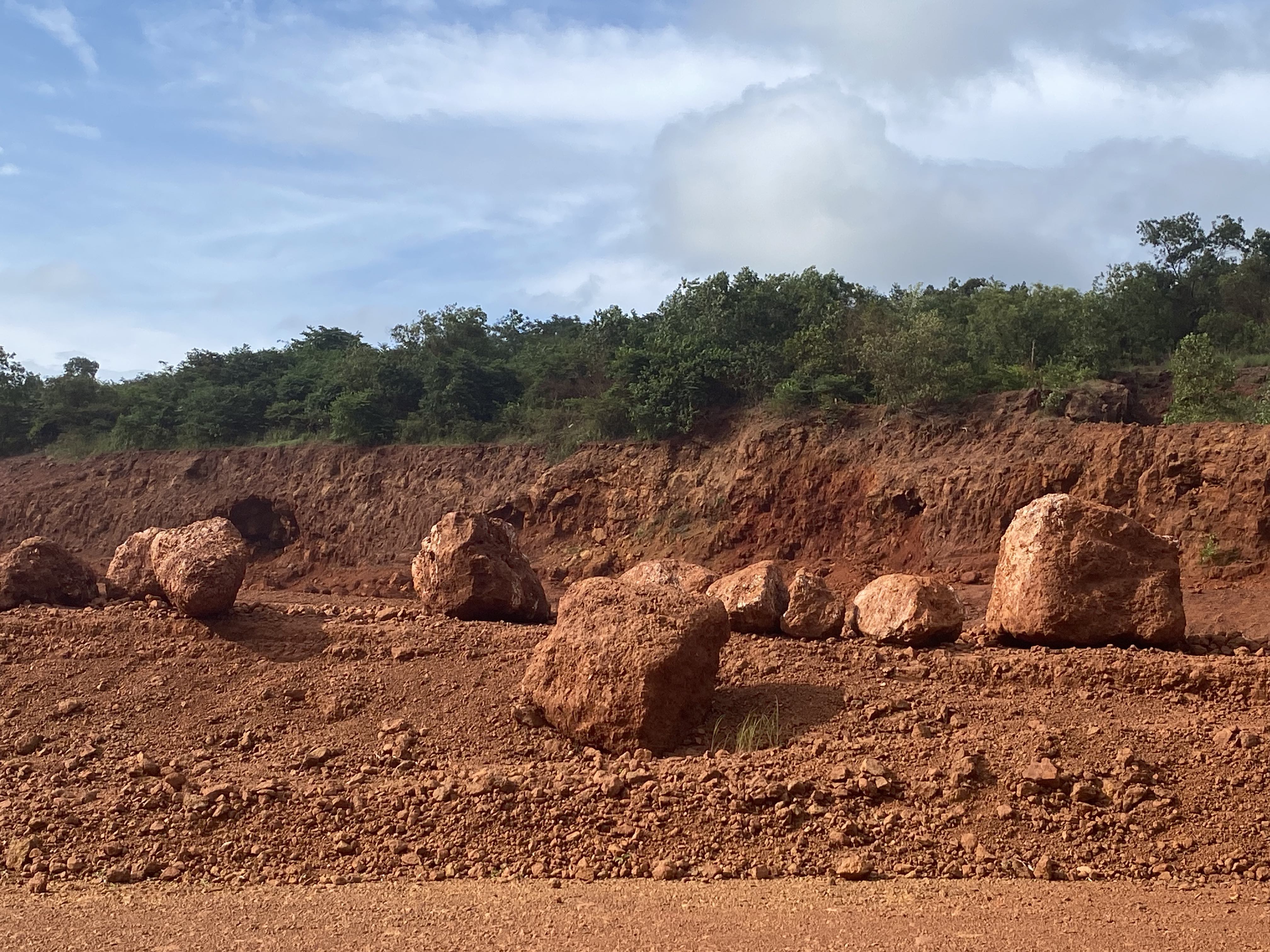
As we moved forward we could see this huge orangish patch of land among the lush green forest of Guinea. This was a very profound moment to experience with our own eyes. We could see how human activity could destroy the beauty of nature. After we reached the entrance of mine which is an open pit mine we made a decision to go back as the terrain was very rough ahead and not suitable for our car. I did pick up a sample of rock to help tell the story to kids back in Conakry we are working with.
On our way back we saw the village outside mine and reflected upon what these mines provide these local people. The revenue earned through these mines is not reaching the people on the ground in Guinea. Russian and Chinese companies that are mining bauxite are earning millions while mining revenues account for only 2% of GDP in tax revenue. The government earns revenue but the majority of it is not getting to the development of local infrastructure. Even the job opportunities at these mines are not available to local people, primarily due to lack of education and training that are adequate for the job.
Through a friend I heard the story of a computer science grad working as a night watchman at a hotel. Yes there are universities that provide higher education but either they lack employable skills or related employment opportunities. Mining companies, even with the best intentions, are unable to help local people due to the skills gap, infrastructure and corruption.
I asked our friend who accompanied us to the mine and who happens to be an ambitious young leader that if he had power and influence what would be his three priorities for Guinea. He said: Education, Roads infrastructure and Clean water.
Priorities
Education: I was fortunate to attend the end of year program for CRS school supported by FCRS. This school was established in the 1990s by the refugees escaping civil wars in Liberia and Sierra Leone and serves the English speaking community. It’s interesting that more and more people in Guinea are interested in English education that could open new doors for them in future as compared to French. Something I could totally connect with my own experiences from growing up in India.
Throughout the program and the day I spent with these kids in school gave me hope for the future, importance of investment in education for Guineans and how they are protecting their culture & values even in less than ideal situations. Yet the challenges are enormous—83% of children can’t read by age 10, and while 98% of enrolled children attend school, they remain learning poor due to quality issues.
Roads Infrastructure: Guinea has an aging road network, particularly in the capital city of Conakry, and this requires significant improvement to support current development and future generations. Poor road conditions create daily challenges for students commuting to school, compounded by the absence of public transportation and costly taxi services. Farmers struggle to transport their produce to markets before spoilage, a problem worsened by inadequate storage facilities that result in the majority of crops rotting and being discarded. Additionally, deteriorating roads limit local businesses’ access to both suppliers and customers, hampering economic growth throughout the region.
Clean Water: Guinea has a six-month wet season, and we witnessed firsthand how heavy the rainfall can be. Yet despite this abundant precipitation, access to safe drinking water remains critically limited. Everywhere we went, even locals relied on expensive plastic water bottles and pouches for drinking water. Only 64% of the population has access to clean water—a figure that has remained stagnant over the past decade. This reliance on bottled water is not only costly for families but also exacerbates pollution and worsens the country’s waste management crisis. Waterborne diseases such as cholera and typhoid, along with vector-borne illnesses like malaria that thrive in areas with poor water infrastructure, have undermined decades of health and development progress. But there is hope with recently approved projects that would bring in an investment of $500 million for water and sanitation projects in Guinea over the next 5 years.
Now the big question is how things could be improved, who should be driving the ‘change’? I will be sharing what I have found as the solution and how you can be part of the solution in my follow up post.
Leave a Reply