A week ago, I redesigned an entire website in 24 hours.
This might not sound remarkable. But for anyone who’s spent years moving between platforms—Blogger, Tumblr, Medium, Squarespace, WordPress—you know the truth: rebuilding a website is brutal. Last year, moving Sostibl.com from Squarespace to WordPress took me a full week of frustrating, painstaking work.
This week, using Claude Cowork, I updated every single page for our new business model in under a day.
The Speed Revolution
The difference matters because it’s not just about my website. After 20 years in IT, I can tell you with certainty: until very recently, a change of this magnitude would have taken a small business owner weeks, if not months—and thousands of dollars to execute. We’re now at a point where every business unit in an enterprise can essentially have its own engineering team.
The opportunity is enormous. Pandora’s box is wide open.
But so is the danger.
The Entry-Level Crisis
My biggest concern isn’t disruption. It’s the gap we’re creating for new graduates—especially computer science majors—entering a profession where the technical barriers to entry are dissolving in real time.
When I coded my first website, there was a clear ladder: learn HTML, master CSS, build something. Technical mastery was a moat. That moat no longer exists. AI can build a website in 24 hours now. It can write clean code, debug systems, and optimize databases faster than most humans can think about it.
So what happens to the entry-level worker when technical execution is no longer a differentiator?
The Wilderness Ahead
My colleague Andy Nichol recently observed something that stuck with me: “AI turns everything into a wilderness because no one knows how it will be in the future.”
He’s right. The historical data and standard operating procedures that once guided decisions are becoming obsolete. We’re moving into territory without maps.
And that’s precisely where the next generation of leaders will either thrive or struggle. Because as AI automates technical tasks at speed, the true differentiator won’t be algorithms. It will be judgment. It will be the ability to lead when the rules haven’t been written yet.

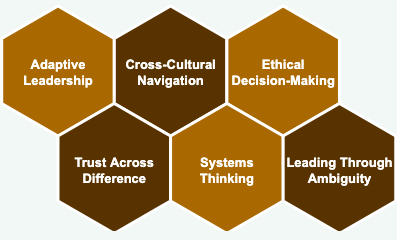
The Six AI-Proof Skills
These are the capabilities that will separate leaders in the AI era:
1. Adaptive Leadership in Unfamiliar Contexts
AI performs best in familiar, data-rich contexts. When context is genuinely novel, human adaptive judgment is irreplaceable. You can’t optimize your way out of truly new territory. You have to think.
In the Impact Innovation Hub, participants work on live Guinea community challenges with no familiar hierarchies, no playbook, and genuine uncertainty about outcomes. There’s no formula. Only judgment.
2. Cross-Cultural Stakeholder Navigation
AI can translate. It cannot build trust across genuine cultural differences or negotiate competing values. Translation is information transfer. Trust is something else entirely—it requires understanding what matters to people across different worlds.
Participants engage with Guinean youth, FCRS staff, and community members across language, culture, and institutional differences for six weeks. They learn that the hardest part of solving a problem isn’t the problem itself. It’s getting people who see the world differently to move in the same direction.
3. Ethical Decision-Making Beyond Optimization
AI optimizes. Ethics involves competing values and decisions that cannot be reversed. You can’t algorithm your way through a choice between speed and inclusion, or efficiency and equity. Those are human judgments.
Participants grapple with exactly these trade-offs in real time. No clean metrics. No algorithm to consult. Just competing goods and the weight of consequence.
4. Building Trust With Different Communities
Trust is built through consistent behavior over time across cultural differences. AI can diagnose trust gaps. It cannot close them. That happens through showing up, following through, and letting your actions speak louder than your credentials.
The program’s core design ensures this: twelve weeks of sustained partnership with a community that has every reason to be skeptical of outside institutions. Trust must be earned, not assumed.
5. Systems Thinking Across Pillars
Seeing a community challenge as an interconnected economic, social, and environmental system requires integrative intelligence that AI lacks in applied contexts. AI can analyze systems in isolation. It struggles with the messy inter dependencies that define real problems.
Community challenges in the program are deliberately multi-dimensional. Participants must map systems before designing interventions. They learn that pulling one lever affects three others—and sometimes in ways the data didn’t predict.
6. Leading Through Ambiguity Without a Playbook
AI performs best when given a clear problem and sufficient data. Real leadership problems are rarely either. The information is incomplete. The question itself is unclear. The right answer is not known in advance.
This is the program’s core design: the question itself is unclear, information is incomplete, and the right answer is not known in advance. Participants don’t solve a problem. They navigate uncertainty. They lead anyway.
These six skills aren’t nice-to-haves. They’re the difference between leaders who execute instructions and leaders who determine what’s actually worth doing.
Why We Built Sostibl
This is exactly what drove the evolution of our new business model.
The Sostibl Impact Innovation Hub isn’t a training program in the traditional sense. It’s an apprenticeship in leading without a map. Corporate executives and young innovators from under served communities are paired together for six weeks. They work on real, resource-constrained challenges in Guinea. They navigate cultural difference, ethical complexity, and genuine uncertainty. They build trust in a community that has no reason to trust them. They learn systems thinking by working within systems that don’t behave predictably.
Both groups develop the same six skills. Both learn what it means to lead when there’s no playbook. The executives gain the adaptive leadership that boards are increasingly demanding—the kind AI will never replicate. The young innovators gain something equally valuable: lived experience, verified outcomes, and relationships with leaders who have navigated the wilderness themselves.
It’s not about replacing technical training. It’s about preparing the next generation for a world where the map has run out.
The Real Constraint
AI can build a website in 24 hours. It can write code, design systems, and optimize processes at a speed that defies human capability.
But it takes uniquely human leadership to determine what the right thing to build actually is—when the map runs out.
That’s the constraint now. Not speed. Wisdom.
The companies and leaders who understand this shift will thrive. Those who keep competing on technical execution will find themselves obsolete far faster than they expected.
The next decade belongs to those who can lead in the wilderness.
Leave a Reply